

Zedex
New Member
My only question is: am I doing this right? I haven't had to chase a short before, so if I'm totally doing this wrong, please point it out. If you think I'm moving in the right direction, please say so.
My new DD is an '02 Accord LX, 4cyl/5sp.
It seems to have an electrical drain. It takes a couple of days of sitting to create a no-start condition.
The starter was just replaced (it used to turn over slow and sometimes needed to be smacked to make it crank). That seems to be fine now, it cranks anytime there is sufficient voltage.
I pulled the negative terminal and ran the multi-meter in series across it, switched it to the mA setting and started pulling fuses.
Long story short: Only one fuse (that I tried) made the meter move. Pulling the 7.5a fuse labeled "clock backup" makes a measurable change. With this fuse out, the meter reads 1.90. With this fuse in, it seems to peg out and reads "1 . " with the gibberish spacing. I interpret this to mean "over 100."
Switching the meter to the "10a" setting and it reads zero with this fuse out and 0.1-0.3 or so with the fuse in.
The clock on the dash has a couple bars that don't light up; I yanked it out of the dash and tossed it aside. Unfortunately, removing the clock did not solve the electrical drain in that circuit.
An even bigger bummer is that my power door locks are somehow connected to this 7.5a fuse (even though they have their own 20a fuse). The FSM wiring diagram just shows a line coming from that fuse going into a "multiplex control unit" which sounds expensive. If my locks still worked I wouldn't give a **** about the clock fuse.

The above image is with the 7.5a clock fuse IN. (sorry for the blur, it was cold and dark)
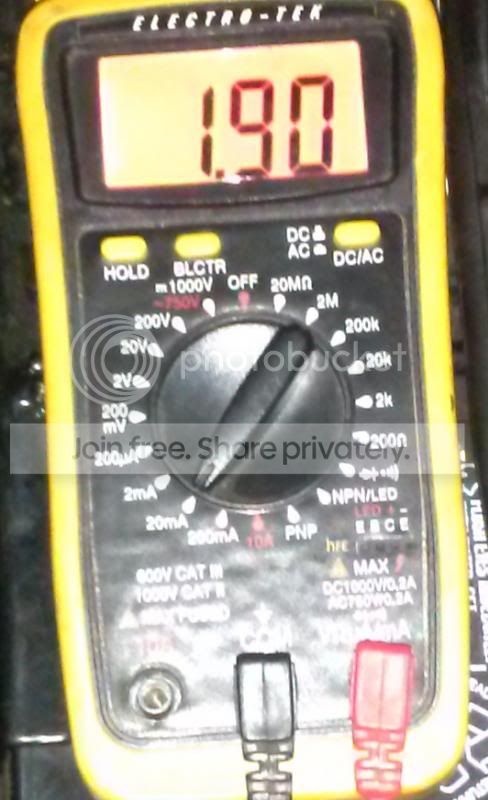
The above image is with the clock fuse OUT.
My new DD is an '02 Accord LX, 4cyl/5sp.
It seems to have an electrical drain. It takes a couple of days of sitting to create a no-start condition.
The starter was just replaced (it used to turn over slow and sometimes needed to be smacked to make it crank). That seems to be fine now, it cranks anytime there is sufficient voltage.
I pulled the negative terminal and ran the multi-meter in series across it, switched it to the mA setting and started pulling fuses.
Long story short: Only one fuse (that I tried) made the meter move. Pulling the 7.5a fuse labeled "clock backup" makes a measurable change. With this fuse out, the meter reads 1.90. With this fuse in, it seems to peg out and reads "1 . " with the gibberish spacing. I interpret this to mean "over 100."
Switching the meter to the "10a" setting and it reads zero with this fuse out and 0.1-0.3 or so with the fuse in.
The clock on the dash has a couple bars that don't light up; I yanked it out of the dash and tossed it aside. Unfortunately, removing the clock did not solve the electrical drain in that circuit.
An even bigger bummer is that my power door locks are somehow connected to this 7.5a fuse (even though they have their own 20a fuse). The FSM wiring diagram just shows a line coming from that fuse going into a "multiplex control unit" which sounds expensive. If my locks still worked I wouldn't give a **** about the clock fuse.

The above image is with the 7.5a clock fuse IN. (sorry for the blur, it was cold and dark)

The above image is with the clock fuse OUT.