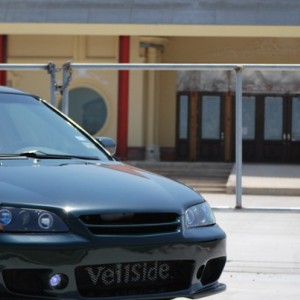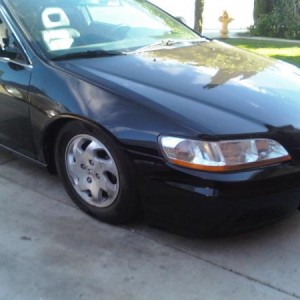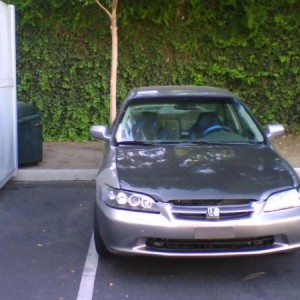

00Accord4cyl
The Orange Skittle
he could get the 3000K hids??



 Im gonna go 6000k Top & Bottom! There gonna be like "dammmmm Look at that benz"

lol yes I know..Blue and violet are the shortest wavelength/highest frequency colors of visible light..which is why it produces more glare and fuzzyness to the human eye because it scatters more etc..but anyway 3500K foglamps for the win.Jeffro said:Actually, Blue is more reflective than white... AND blue travels farther than white, believe it or not. Have you ever seen those flashlights with a white and a blue LED? You can see better with the white, but you can stand from further away with the blue and still get light there...
also don't forget to mention Lumens is what your determines your output..since he thought Kelvins didJeffro said:What makes 2000K brighter than the sun? The "K" isn't how bright something is, it is the "Color Temperature." Expressed in Degrees Kelvin, or "K". It's referring to the wavelength (color) involved, not how bright something is.
If you study Photography or Videography (me) you study this concept extensively, because it is everything to a camera. 2000K would be a very orange, possibly red light (I'll have to check). Tungsten Lighting (i.e. Standard household lightbulb) is considered 3200K on average, based on how yellow it is. I forget flourescent's exactly, but I think it was around 4000-4500K. Outside light, in the shade, is "averaged" to be 5600K. The sun can range all the way up to something like 12,000K or something like that. Again, this is the color of the light as our eyes pick it up, and the wavelength(s) being emitted.
There's a brief (or long, depending on how you look at it) explanation ot color temperatures. It is why 10,000K looks violet, 6500K looks blue, etc. 2000K would look orange.
shavedaccord said:also don't forget to mention Lumens is what your determines your output..since he thought Kelvins did